
About Us
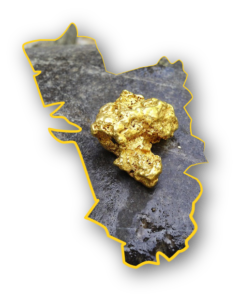
Our research, published in several peer-reviewed journals, makes two fundamental and paradigm-shifting claims:
1. There is appreciable and economically exploitable gold in the iron ore belt of Goa, independent of iron oxide content, which typically ranges between 42–68%.
2. The gold in this region is of volcanosedimentary and geomicrobial origin, and the process of secondary gold mineralisation has been consistently hidden or ignored by iron ore mining interests since 1945-46.
Our studies reveal that gold in Goa exists in multiple distinct forms:
A. Primary Gold
Found as crystalline auriferous quartz or gold bound to silica and other metal complexes such as copper and arsenic.
B. Secondary Gold
B.1. As nanoparticles formed by erosion, ranging from 1 to 800 nanometres. In plant ash residues, these occur as unique forms called Auroliths.
B.2. As microparticles or nuggets with regular or irregular geometries, sized from over 1 micrometre to hundreds of micrometres.
B.3. As bacterioform gold (in sensu Reith) or microbioform gold, whose morphologies indicate origins in ancient microbial biooxidation or bioreduction, often detectable as microfossils.
B.4. As organically bound gold, including gold complexed with humic acids, amino acids, and other organic matrices.
B.5. As gold sulphides, which are globally rare and exist in only two known forms: diauric trisulphide (Au₂S₃) and monoauric sulphide (AuS). These are detectable after demagnetisation of iron ore samples like Banded Hematite Quartzite (BHQ) and Banded Magnetite Quartzite (BMQ).
Our pioneer discovery that gold sulphides exist in Goan iron ore — up to 9% by weight in the heavy, non-ferrous fraction — represents a major shift from the iron-centric discourse that has dominated mining in Goa. Our data clearly show that the gold sulphide content matches the total recoverable gold content in these ores.
We have twice submitted detailed technical petitions and presentations to the Hon. Chief Minister of Goa — on June 20, 2019 and June 29, 2022 — urging the government to take a comprehensive analytical approach. We demanded that all forms and chemical species of gold in Goa’s mineral resources be properly quantified in parts per million (ppm) or grams per metric tonne (g/t), before any decisions are made to permit mining.
Failing to do so will amount to historic plunder: private miners could extract large quantities of undisclosed gold while officially mining for iron, with no public accountability. This would be a catastrophic loss of national wealth.
To date, neither the state nor central government has released a complete geochemical profile of Goa’s iron ores — whether BHQ, BMQ, Goethite, Limonite, or ferromanganese ores. Their attention remains narrowly focused on primary gold, neglecting the multi-elemental and bio-geochemical spectrum of metals in these rocks.
There is reason to believe that several trillion dollars’ worth of secondary gold from Goa has already been exported — embedded in iron ore shipped to China, Japan, South Korea, and Taiwan, where sophisticated metallurgical technologies allow silent extraction of gold and other metals. These countries have no obligation to disclose what they recover.
A knowledge-based mining strategy has never been pursued in Goa. The most fundamental question — “Besides iron, what other metals are present in the exported ore, and in what concentration?” — as never been asked. This omission represents a Himalayan blunder of policy, governance, and scientific oversight.
Since 2011, all my efforts to raise awareness — through publications, presentations, petitions, and discussions with miners, media, officials, and policymakers — have gone unanswered. Yet the evidence is undeniable:
Cherty iron ore means silica-bound gold
Sulphidic iron ore means gold sulphide and trace metal sulphides Goa has the potential to profit not just from iron oxide but also from secondary gold. Any future mining strategy must take both into account. If properly managed, India’s foreign debt could be eliminated, and Goa could emerge as the richest region on Earth within five years.
Our Vision
This website strongly advocates a new, gold-based economic future for Goa. We call for an immediate halt to the export or extraction of auriferous ores and sands, unless there is a complete multielemental geochemical analysis on a 100% dry weight basis, including quantification of gold and gold sulphide content.
We believe it is the duty of civil society to demand this. No mining operation should be allowed to continue unless all elemental values — not just iron — are known, reported, and publicly disclosed.
What You’ll Find Here
This website serves as a comprehensive digital repository of:
Peer-reviewed research papers
Petitions and government submissions
Detailed analytical data
Photographs, photo and electron micrographs
Reports, interviews, press briefings, and video links
Contributions from my MSc and PhD research students
And original work spanning more than a decade of investigation
Together, these materials support our claim that Goa’s future prosperity lies buried not just in iron, but in gold.
Let us unearth it — wisely, transparently, and justly.